Single Cut, Infinite Cells
No artist is born from a void. I did not “discover” my style—I recognized it from those who preceded me in art history. I found a vein—I recognized it because that vein was already flowing within me.
Sharp contrasts. Patterns with black backgrounds, reminiscent of katana cuts, evolving toward order. Blood, cells, electric blue, and dominance. These are not my inventions. In fact, they are this century’s echo of a 600-year-old tradition.
I. Hitofude — Single Brush, Single Cut
Sesshū Tōyō (1420-1506), Japanese ink painter. Hitofude-gaki. The line drawn in a single breath. No turning back. When you lift the brush, the painting ends—it is either perfect, or it is garbage.

Ensō — the circle drawn by Zen monks in a single stroke. Imperfection is perfection. Incompleteness is a testament to the ongoing process.
Ikken Hissatsu — “one strike, certain death.” The aesthetic axiom of Bushido: there is no second chance. In kenjutsu, the hand that draws the katana also holds the brush. Mushin — the mind must be in neither the brush nor the sword. Only the flow.
Modern art loves to say “the process is what matters.” Nonsense. What matters is the certainty of the moment. When the Sumi-e master lifts the brush, the painting ends. Musashi, the most proficient warrior in history, says, “strike once, strike once, strike once.” Furthermore, this principle applies to the art he created. (Yes, he was also a talented painter.) Everything in between is just theory from those trying to hide their own incompetence.
This is why Lucio Fontana resonates with me. The Italian artist, the man who cut the canvas. Hitofude that Europe discovered 500 years too late. Fontana uses a scalpel instead of a brush, but he holds the same state of mind: a single movement, irreversible, precise.

II. Game of Life — The Empire of the Cell
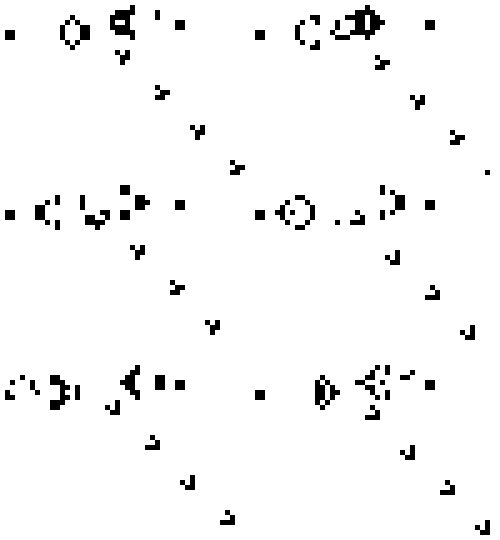
John Conway (1937-2020) created the Game of Life in 1970. 4 simple rules:
- A living cell with 2-3 live neighbors survives.
- A living cell with fewer than 2 live neighbors dies (underpopulation).
- A living cell with more than 3 live neighbors dies (overpopulation).
- A dead cell with exactly 3 live neighbors becomes a live cell.
From these rules, the glider, pulsar, and gosper glider gun were born. Emergent complexity. Infinite forms from simple rules.
I had written a chapter on the Game of Life in Simulacrum — as the purest visualization of the universe’s deterministic yet emergent structure.
Look at the Game of Life screen — a black background, cells are born and die, organized patterns emerge from simple rules. This is already the origin of my TouchDesigner aesthetic.
There is a striking parallel between Bushido and the Game of Life: it does not step outside the rules — seppuku. It produces infinite form within the rules — zanshin (continuous awareness). Cellular automata function like samurai code: the rule is absolute, the expression is limitless.
III. The Modern Vein — Data and Authority
Vera Molnár (1924-2023), the first woman artist to draw with a computer. The Désordres series: from chaos to order, from order to chaos. A pioneer of algorithmic art.

Manfred Mohr (1938-), the father of black-and-white algorithmic art. Geometric distributions. Visualization of rules.

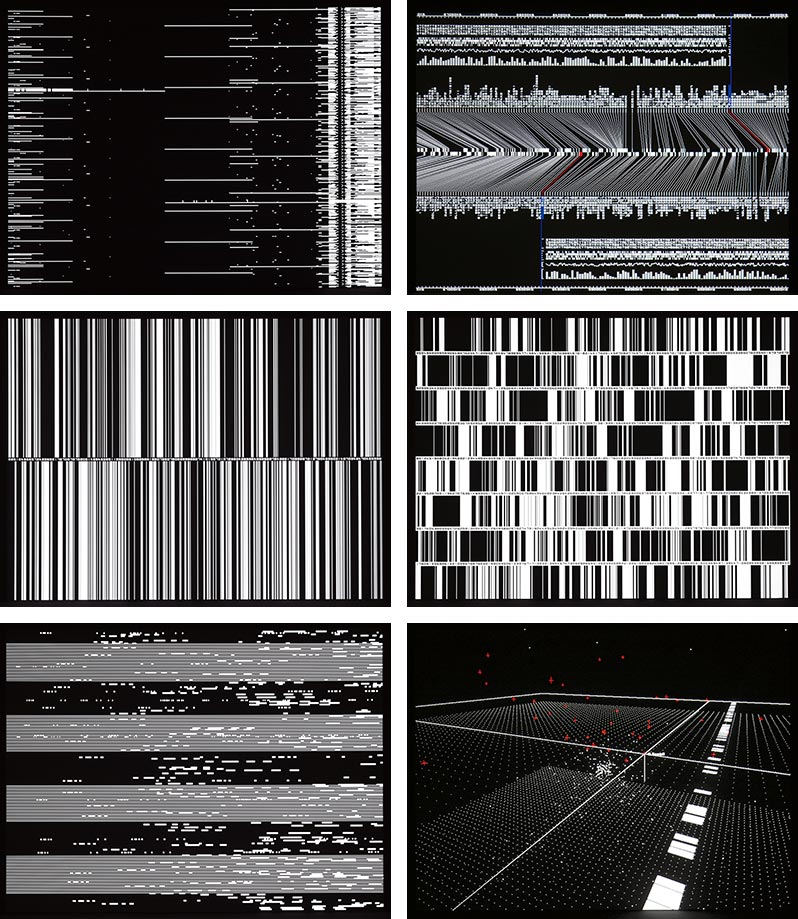
Ryoji Ikeda (1966-), the living master of data art. White/blue datapoints on black. The man who turns concert halls into mathematics. He pushes the boundaries of data aesthetics in his data.scan and test pattern series.
V. Synthesis — Why is TouchDesigner the Natural Heir to This Vein?
Sesshū lifted his brush once. Fontana cut his canvas once. Conway wrote his rules once. All were limited by one thing: time.
What TouchDesigner gives me is this: the cut can be alive. The rule processes every scene (60 or 30 times per second). This means the cell is born and dies 60 times a second.
Photoshop is a corpse — built to apply makeup to dead pixels. After Effects is a reception desk — it lines up footage shot by others. Unity is a game store. (Yes, unfortunately.) Blender is a sculpture workshop.
TouchDesigner, however, is a madrasa. You open it every day, run the rule, the cells are born. When you cut correctly, you don’t feel satisfied — you feel obliged. When you cut wrongly, it’s not a lesson — you feel shame. This is why I love it: because I don’t enjoy working with it, I enjoy playing with it.

VI. My Style?
A human is a dynamic creature. Their ideas, their emotions change. I love my style. However, I do not want it to be immutable.
EOF.