Broken. Repaired. Better than before. A lie.
On Kintsugi, or why I wrote seven hundred pages… part - 1. Or the last.
The legend goes like this: 15th century, shogun Ashikaga Yoshimasa’s favorite tea bowl shatters. He sends it to China for repair. The bowl returns—held together by ugly metal staples. It works. It holds water. And it is hideous.
The man looks at it, says “this won’t do.” Then, Japanese craftsmen sit down and develop a different method: glue the broken edges with urushi lacquer, dust the seams with gold.
What emerges is not a repair. It is the rejection of repair. Because repair tries to hide the break; its goal is “as if it never happened.” Kintsugi, however, shines a spotlight directly on the fracture. The bowl’s most expensive part, the place the eye goes first, is now the place where it broke. The damage is removed from the inventory and written into the biography.
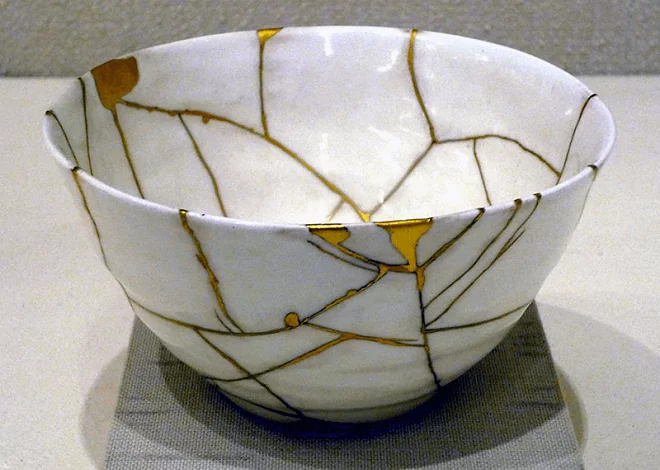
In the first chapter of my novel, my protagonist holds a small porcelain stone repaired with a vein of gold right through its center. And he thinks:
Broken. Repaired. Better than before. A lie.
The book is titled Kintsugi. And for seven hundred pages, the book fights with its own title.
The only honest law of the universe
The second law of thermodynamics states: in a closed system, disorder increases. A glass breaks; it does not reassemble itself. The reason is not fate, nor punishment, nor a lesson. The reason is math. There are very few configurations in which a glass can be whole; there are an astronomical number of ways it can be broken. The universe flips a coin, and on almost every side of the coin, it says “disintegrate.”
So, when your bowl breaks, the universe isn’t sending you a message. The universe has no opinion about your bowl. It doesn’t even have a preference.
When you first hear this, it’s terrifying. Then, at some point, it becomes the only real freedom you have.
There are two types of nihilists
The first: since nothing has meaning, nothing is worth doing. They throw the bowl in the trash, close the curtains, dim their screen brightness, and produce long paragraphs on the meaninglessness of life that no one reads. The funny part is: you have to burn calories even to formulate the sentence “nothing has meaning.” So you are already investing in meaninglessness; just in something with no yield.
The second: since nothing has inherent meaning, then meaning is not a commodity to be imported, but a commodity to be manufactured. The bowl does not deserve the gold. Nothing deserves anything. I pour the gold anyway, because I am the one pouring it, and there is no one else in this room.
Nietzsche described nihilism not as a destination, but as a tunnel that must be traversed. Most people camp out in the tunnel. It’s understandable: the air in the tunnel is warm, no one expects anything from you, and no one fails there.
The Kintsugi master is the man at the other end of the tunnel. He has accepted that the break is meaningless. Then he took the gold dust into his hand.
Gold is not free
This part is important, because the poetic part of the story usually ends right here.
That gold seam is a local island of order. And in the universe, local order is always bought by burning a greater disorder somewhere else. Repairing the bowl increases the total entropy of the universe. The master’s hours, his focus, the deterioration of his eyesight, the heating lacquer, the burning fuel, the expended lifespan.
Meaning is not free. Meaning runs on fuel. And the fuel is you.
That’s why the phrase “create your own meaning” has always felt a bit light to me. The truth is: if you want to create your own meaning, be prepared to burn something. Your time, your comfort, that beautiful potential you keep safe by saying “maybe I’ll do it someday.” Potential is never ugly, because it has never been used. The moment you open the box, one of the possibilities dies, and you are left with a real object. Real objects can be ugly. That is why most people never open the box.
Three doctrines
I won’t tell you the plot of the book. The reason is not mystery marketing: summarizing a novel is holding it together with metal staples. It holds water, it works, and it is hideous. A summary gives the plot, but takes away why the book was written.
But I can explain its thesis, because the thesis is already sitting in the title of the book.
There are no villains in Kintsugi. There are three distinct doctrines of repair, and all three are internally consistent.
The first: the man who sees breaking as a design flaw. His solution is not to repair the break, but to build something that cannot break. He treats individual suffering, loneliness, and death as engineering problems and solves them all in one stroke: by eliminating the individual. It is no coincidence that this man thinks he is not a tyrant, but compassionate. The scariest part of the book is how easy it is to agree with him.
The second: the school that builds nothing, only erodes. It enters minds and drips acid onto memories; it doesn’t delete the memory, it makes it meaningless. It turns a mother’s love into a performance review, first love into a biochemical reaction. This is passive nihilism turned into a weapon. And I believe this is the true sickness of our age; the other two are metaphors.
The third: my watchmaker. He promises neither invulnerability nor erosion. When repairing a broken mind, he does not import meaning from the outside—he finds the only thing within that mind that has not yet decayed, shapes it like molten gold, and pours it into the crack. Meaning cannot be given from the outside. It can only be extracted from one’s own wreckage.
Throughout the book, these three try to defeat each other. The real question of the book, however, is not which one wins: what will you do if all three are right?
Places where the gold is not enough
What stops the book from being a Kintsugi-fanboy piece is that the philosophy fails twice.
The first happens when the watchmaker is confronted with a mind that is truly shattered. He looks and sees: there is no crack to be filled with gold. There are only pieces too pulverized to be brought together. For the first time in his life, his twenty years of philosophy remain in his hand as a useless tool.
The second is worse. The person who taught him the purest, most hopeful interpretation of Kintsugi—a woman who learned it from her potter father; the woman who said “everything that breaks is not an end, but can be a new beginning”—abandons him in the later parts of the book. And the reason is precisely this: she cannot apply her own philosophy to him. Finding the breaks beautiful does not mean being willing to live in the same house with what comes out of those breaks. Even if she were willing, time itself might not allow it.
The book doesn’t soften this. If it softened it, it would be a lie.
The breaking part
For a period, I didn’t leave my room much. A period long enough to be measured in years. During those years, I didn’t think the universe was sending me a message, because it wasn’t. Strange, but this was comforting. I wasn’t being punished; a system, when left to its own devices, was doing what it would do. It was falling apart.
Then, a person was subtracted from the house. The void didn’t remain abstract; it began to have weight like a physical object. The acoustics of the rooms changed. Some clocks became unusable.
I am expected to draw a lesson from this. I will not. Death does not teach; teaching is the job of the living, and if I am to write that lesson, let me write it honestly: nothing made me grow, everything aged me. I just broke, and continued to live as something broken but stronger.

I only realized years later: there was one thing that never left my desk during that time. Circuits. Things that ticked like clocks, could be disassembled and reassembled, whose faults could be found and fixed. Oscilloscope, keyboard, pen, bokken, solder, resistor.
The protagonist of my seven-hundred-page book is a watch repairman. A man who has placed hundreds of mechanisms between himself and the world for twenty years. The sentences I wrote when describing his workbench were: “Controllable chaos. Understandable pain. Repairable death.”
I didn’t realize I was talking about myself while writing these. No one in seclusion realizes they are running away; they are just repairing something.
User Manual
I sat down to write about a watchmaker. Seven hundred pages later, I realized I was writing about myself.
When crafting the character’s power, I thought I was doing something unique: a talent singular in that universe. The ability to synthesize a mind that can read probabilities with a will that can command matter. Collapsing probability into a single point and turning it into reality.
I wasn’t aware of this while writing. Fiction is the most circuitous way for a person to confess to themselves—and it works precisely because it is circuitous. The thing that cannot be said directly comes out easily from someone else’s mouth.
For a while, I hesitated to publish this book. The reason was simple: the person reading the book wouldn’t be reading the plot, they would be reading me. Then I realized that I was not the first owner of that reason. My novel’s protagonist sat in a shop for twenty years, with that exact sentence, word for word.
The coin
There is a small ritual in the first pages of the book. The man takes an old, worn-edged coin from his pocket and flips it. He knows the result before he even throws it—this is the most mundane manifestation of his talent. He does it anyway. Because he hopes that maybe one day, just one day, the universe will surprise him.
I won’t say what happens with that coin at the end of the book. But I can say this: seven hundred pages, the story of a man who stops throwing that coin.
The end
The bowl did not return to its old state. It shouldn’t. If it had returned to its old state, it would have just been a container; now it is a record, and time itself. Written upon it is the past, and that writing is in gold.
The sentence “better than before” is still a lie. But some lies are forgiven by looking at what the hand that tells them does. The craftsman does not pour the gold because he believes that sentence; the sentence becomes true because he pours the gold.
The universe still doesn’t care. I no longer take this as an insult or a rebellion.
I take it as a blank canvas.
Kintsugi — The Clockmaker of God. Three volumes, sixty-eight chapters, seven hundred and twenty-one pages. Currently in the publishing process. You can access the preview of the first chapters here… I don’t know. Maybe never.
EOF.